

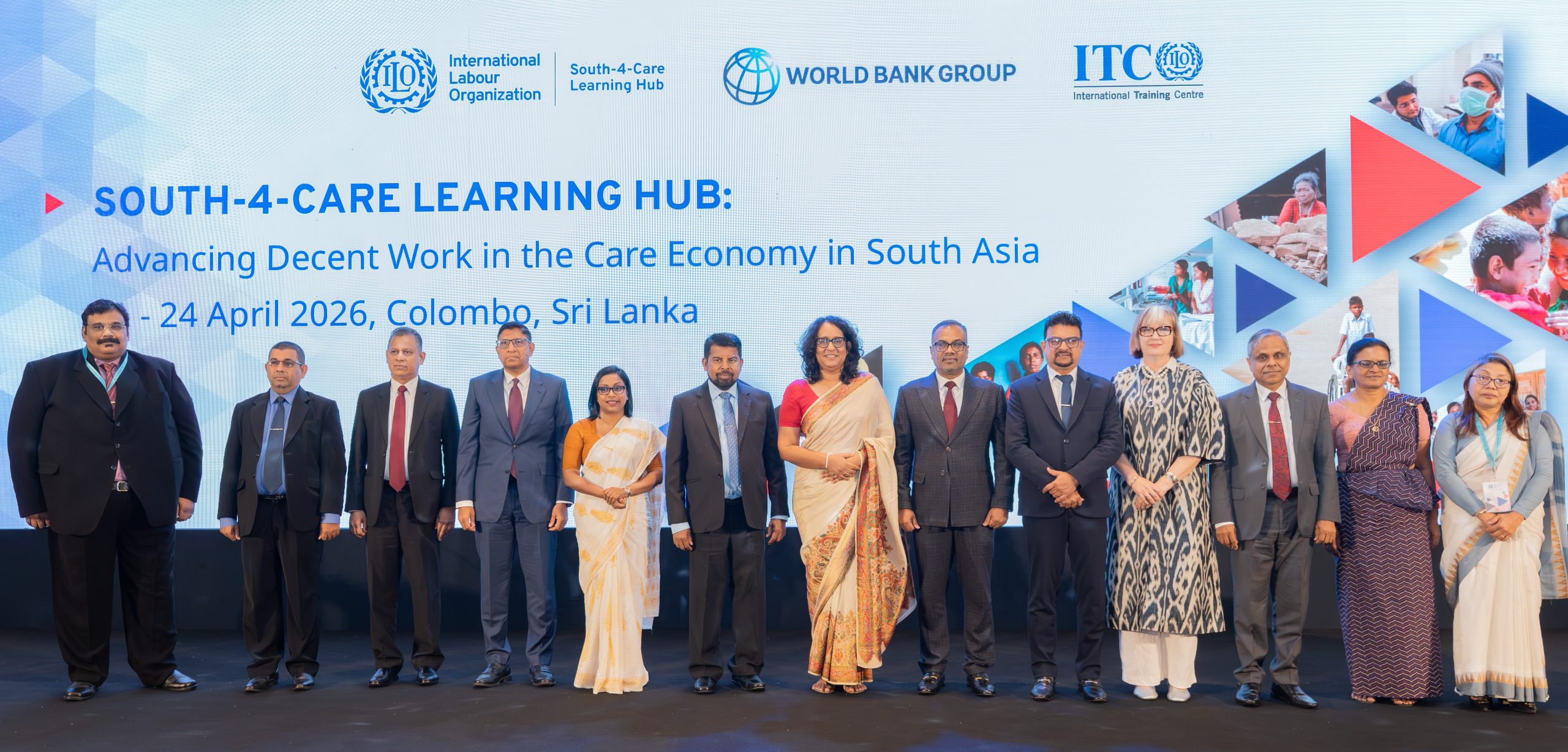
Discussions at the ILO-organized South-4-Care Learning Hub highlighted that progress in the care economy across South Asia is within reach when governments, employers and workers act together through coherent policies and social dialogue.
Countries across South Asia came together to advance decent work in the care economy through a four-day South-South knowledge exchange and capacity-building initiative organized by the International Labour Organization (ILO), in partnership with the World Bank Group, and in collaboration with the International Training Centre of the ILO (ITCILO).
The South-4-Care Learning Hub: Advancing Decent Work in the Care Economy in South Asia, taking place from 21–24 April 2026 in Colombo, provided a regional platform for South-South and Triangular Cooperation, enabling countries at different stages of development to exchange experiences, build capacity and identify pathways of building towards gender-responsive and resilient economies.
Delivering the inaugural address, Dr. Harini Amarasuriya, Honourable Prime Minister of the Democratic Socialist Republic of Sri Lanka highlighted stated that “the care issue, the care economy, is no longer a peripheral issue. It is central to how our economies function and how our societies sustain themselves”.
“Labour force participation is not simply about productivity, it is about access to opportunity, dignity and inclusion,” she said, adding that no form of work, whether paid or unpaid, formal or informal, should remain invisible, undervalued, or underprotected.
Participants underscored that advancing decent work in the care economy in South Asia requires coordinated and sustained action grounded in social dialogue, public investment and policy coherence. Discussions highlighted the importance of strengthening care systems through inclusive policies that respond to rising care needs while improving working conditions and protections for care workers.
The panels emphasized the critical role of national actors- including governments, employers’ organizations, trade unions, private sector actors and experts- in shaping effective care policies and services. Participants shared practical experiences and initiatives demonstrating how social dialogue, partnerships and coordinated action can translate policy commitments into tangible outcomes.
Care work – both paid and unpaid – is essential to the functioning of societies and economies. It enables people to participate in the labour market, supports families and communities, and underpins productivity and economic growth. Yet across South Asia, care work remains undervalued and unevenly distributed, with women bearing a disproportionate share. Limited access to affordable and quality care services continues to restrict women’s labour force participation and deepen gender inequalities.
Recognizing these challenges, the ILO adopted the Resolution concerning Decent Work and the Care Economy. It affirms care as vital labour market infrastructure and calls for coordinated action to ensure access to quality care services while improving working conditions, rights and protections for care workers. It emphasizes a rights-based, gender-responsive approach anchored in international labour standards, social dialogue and public investment.
By fostering shared learning and regional collaboration, the Learning Hub aims to support countries in translating global commitments on care into concrete national action – strengthening care systems that work for workers, enterprises and societies alike.
Leave a Reply